Walk down any block in Philadelphia and you’ll see glass everywhere. The floor-to-ceiling storefronts along Chestnut and Market Streets in Center City, the tall original windows on Fishtown row homes, the display windows of Old City’s galleries and boutiques — glass is part of what makes this city feel open and inviting. It’s also one of the most vulnerable parts of any building. A thrown brick, a crowbar, a burst of storm-driven debris, or an attempted break-in can turn a pane of glass into an open door in seconds.
The security window film Philadelphia businesses and homeowners install today was designed to solve exactly that problem. For property owners — retail landlords, restaurant operators, homeowners in older row homes, facility managers for schools and offices — security film is one of the most cost-effective ways to harden a building’s most fragile entry points without changing the way it looks.
What Security Window Film Actually Does
Security window film is a thick, optically clear polyester or laminate film — typically 4 to 14 mils — bonded to the interior surface of your existing glass. Unlike decorative or solar films, its job is structural: when glass is struck, the film holds the broken fragments together instead of letting them scatter or fall out of the frame.
That single change has a cascade of benefits:
- Slowed forced entry. A smashed window with film stays mostly in place, clinging to the frame. An intruder has to keep cutting and pulling through a flexible membrane, which takes far longer and draws far more attention than hitting bare glass.
- Reduced shatter injuries. Glass breakage from accidents, seismic movement, or blasts produces flying shards that cause most glass-related injuries. Film keeps fragments attached to the sheet.
- Storm protection. Philadelphia’s hot, humid summers regularly deliver severe thunderstorms with straight-line winds and flying debris. Film helps keep wind and water out when a window is struck.
- Graffiti and etching defense (optional layer). Exterior anti-graffiti film can be layered over vulnerable street-level glass so taggers’ etching attacks hit a replaceable sacrificial surface instead of your glazing.
For extra strength, film can be paired with a structural silicone attachment system that bonds the film edge to the frame, dramatically improving how long the glass-and-film assembly stays in place under sustained attack or pressure. (If your priority is shard containment rather than intrusion delay, our safety and security film overview breaks down the product categories.)
Why Philadelphia Buildings Are Particularly Vulnerable
Philadelphia’s building stock is old — much older than the glass in it. Walk through Old City or Queen Village and you’re looking at buildings whose footprints date to the 1700s and 1800s. Fishtown, Kensington, and Port Richmond row homes from the late 19th and early 20th centuries often still have large ground-floor windows and sometimes original or early-replacement glazing that simply wasn’t designed to resist impact.
Add the urban realities:
- Street-level retail exposure. Center City’s commercial corridors, from Rittenhouse Square to East Passyunk, put thousands of square feet of glass at sidewalk level. Retail smash-and-grab theft is a crime of seconds; anything that stretches those seconds matters.
- Vacancy and construction corridors. Neighborhoods in transition see more vandalism on unattended glass, and construction zones throughout the city generate airborne debris.
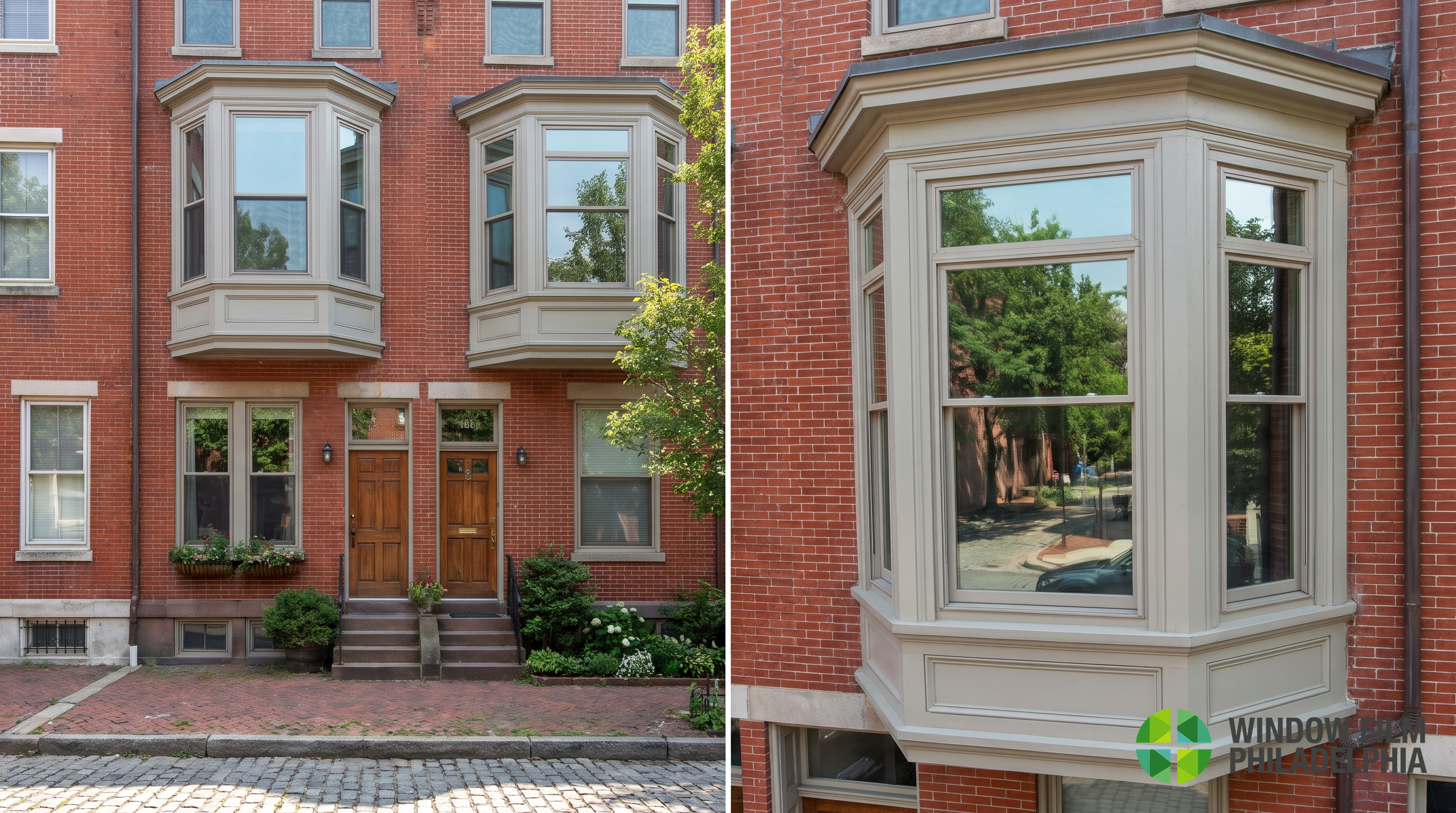
- Historic district constraints. In districts overseen by the Philadelphia Historical Commission, replacing historic windows with impact-rated glazing can be a slow, expensive, sometimes prohibited proposition. Security film is applied to the interior surface and is virtually invisible, making it one of the few retrofits that respects historic fabric while still upgrading performance.
- Climate stress. Hot humid summers followed by freezing winters put constant thermal cycling on old glazing and its seals. Film also blocks 99% of UV rays, which protects the interiors — hardwood floors, merchandise, upholstery, and historic textiles — from fading.
Security Window Film Philadelphia Retailers Count On Against Smash-and-Grab
Talk to Center City and Old City retailers and the same story comes up again and again: a vehicle or a group of individuals hits a storefront, the glass goes down in one blow, and merchandise is out the door before anyone can respond. Police response time — even a good one — is measured in minutes. A bare pane of glass fails in one second.
Security film doesn’t make a storefront unbreakable, and no honest installer will tell you it does. What it does is change the math. A filmed pane that’s struck with a hammer or brick cracks but holds; the attacker has to work through a bonded membrane, often on multiple panes, exposed on a busy sidewalk the entire time. Many would-be thieves simply move on. Our retail window film applications guide covers how storefront glazing gets hardened in practice. That delay — often 30 seconds to several minutes depending on film thickness, glass type, and attachment method — is frequently enough to turn an easy hit into a failed attempt.
This is the same principle used by jewelers, pharmacies, government buildings, and schools across the country, and it’s why the U.S. Department of Homeland Security publishes guidance on shatter-resistant window film as a protective measure for buildings. Federal security guidance treats fragment-retention film as a baseline mitigation against blast, burglary, and severe weather — the same three threats Philadelphia buildings face.
What About Homes? Row Homes and Security Film
Homeowners sometimes assume security film is a commercial product. In Philadelphia, that’s a mistake of geography. Row homes are defined by shared walls and glass on the front and rear exposures — and rear ground-floor windows and basement-level windows are the two most common residential entry points for break-ins precisely because they’re shielded from street view.
For Fishtown, Northern Liberties, West Philly, and Germantown row homes, security film is a practical fit because:
- It works on existing windows, including the original wood-sash windows that give these homes their character — no window replacement, no change to the facade.
- It’s substantially cheaper than laminated glass replacement or impact glazing, usually a fraction of the cost per window.
- It’s retrofitted in hours, not days, with little disruption.
- It delivers bonus benefits: UV fading protection, modest heat rejection (or choose a solar-security hybrid film to cut summer cooling loads), and reduced shatter risk if a kid, a baseball, or a lawn projectile meets a window.
Pair it with decent locks, motion lighting at the rear of the house, and trimmed shrubs, and you’ve addressed the most common residential entry paths for a few hundred dollars per vulnerable window.
Choosing the Right Film: Thickness, Attachment, and Certification
Not all security film is created equal, and this is where a knowledgeable installer earns their fee. Three factors matter most:
1. Thickness. Film is measured in mils (thousandths of an inch). Common security ratings:
- 4–7 mil: Standard safety/security film for residential windows and low-risk commercial glass. Handles accident and modest intrusion scenarios.
- 8–11 mil: Thicker film for storefronts, ground-floor retail, and doors. Better endurance against sustained attack.
- 12–14 mil and up: Heavy-duty film for high-threat applications, often paired with attachment systems.
2. Attachment method. Standard film is applied to the glass with a daylit edge (a small gap at the perimeter). For higher security, an attachment system — structural silicone or a mechanical batten — anchors the film to the frame so the whole assembly resists being pushed in. If your threat model is smash-and-grab burglary rather than just shard containment, ask about attachment. It’s the difference between good and very good.
3. Certification and testing. Quality security films are tested to standards like ANSI Z97.1, UL 972 (burglary-resisting glazing), and ASTM impact tests. Ask your installer which product they’re proposing and what it’s tested for. Reputable manufacturers (3M, LLumar, and others) publish test data; a professional installer should be able to show you the spec sheet for the exact film going on your glass.
What Installation Looks Like
One of the reasons security film is so popular in a dense city like Philadelphia is that installation is fast and non-disruptive:
- Glass assessment. The installer checks glass type, thickness, frame condition, and existing film. Old or damaged film must be removed first.
- Surface prep. Glass is cleaned thoroughly — any trapped dust becomes a visible defect under thick film.
- Film application. Film is cut to size and applied to the interior surface with a mounting solution, squeegeed to remove bubbles, and trimmed.
- Curing. The film takes several days to a few weeks to fully cure depending on weather and humidity — expect slight haziness or tiny water bubbles early on that disappear as it dries. Philadelphia’s humid summers actually extend cure times; plan accordingly.
- (Optional) attachment installation. If you’ve opted for a silicone or batten attachment system, that’s completed after the film cures.
Most storefront projects are done overnight or over a weekend so a business never loses selling hours. A typical row home takes a few hours.
Cost and Value in the Philadelphia Market
When you compare quotes for security window film Philadelphia projects, pricing varies with film thickness, glass condition, square footage, and whether an attachment system is included, but as a planning number, security film generally runs significantly less per window than replacing the same window with laminated or impact glass — often a fraction of the cost. For a storefront with several large panes, the film cost is typically recouped the first time it prevents a single break-in, to say nothing of avoiding a smashed pane’s replacement cost, boarded-up days of lost sales, and the insurance hassle that follows.
Many property insurance carriers look favorably on documented security upgrades, so it’s worth mentioning the installation to your agent.
Common Questions
Will it make my windows look tinted? No. Security films are optically clear. If you also want heat and glare reduction, clear and tinted solar-security hybrid films exist.
Can it be applied to old wavy glass? Usually, yes — but the installer must verify the glass is structurally sound. Severely degraded glass may need replacement first. On historic windows this is a case-by-case call, and a good installer will walk the building with you before quoting.
Does film stop bullets? No. Bullet-resistant glazing is a completely different product category. Security film is about forced entry, shards, and impact — not gunfire.
What about thermal stress cracking? Absorbed solar heat can stress some glass types. A professional installer evaluates your glass (especially large tinted or reflective panes) and selects a film that’s safe for that glazing. This is exactly why DIY security film on commercial glass is a bad idea.
The Bottom Line
Philadelphia’s architecture is one of its greatest assets, and its glass — from Old City’s retail display windows to Fishtown’s row home sashes — is part of that character. But glass is fragile, and the threats are real: burglary, storms, vandalism, accidents. Security window film is the rare upgrade that protects what’s behind the glass without touching the glass’s appearance, the historic fabric of the building, or your budget in any dramatic way.
If you manage a storefront in Center City, run a restaurant in Old City, or own a row home in Fishtown, a site assessment is the natural next step. A professional evaluation of your glass, your exposure, and your threat level will tell you exactly which film thickness and attachment method makes sense — and most estimates are free.
Ready to protect what’s behind the glass? Contact us for a free security window film Philadelphia consultation and on-site quote.