
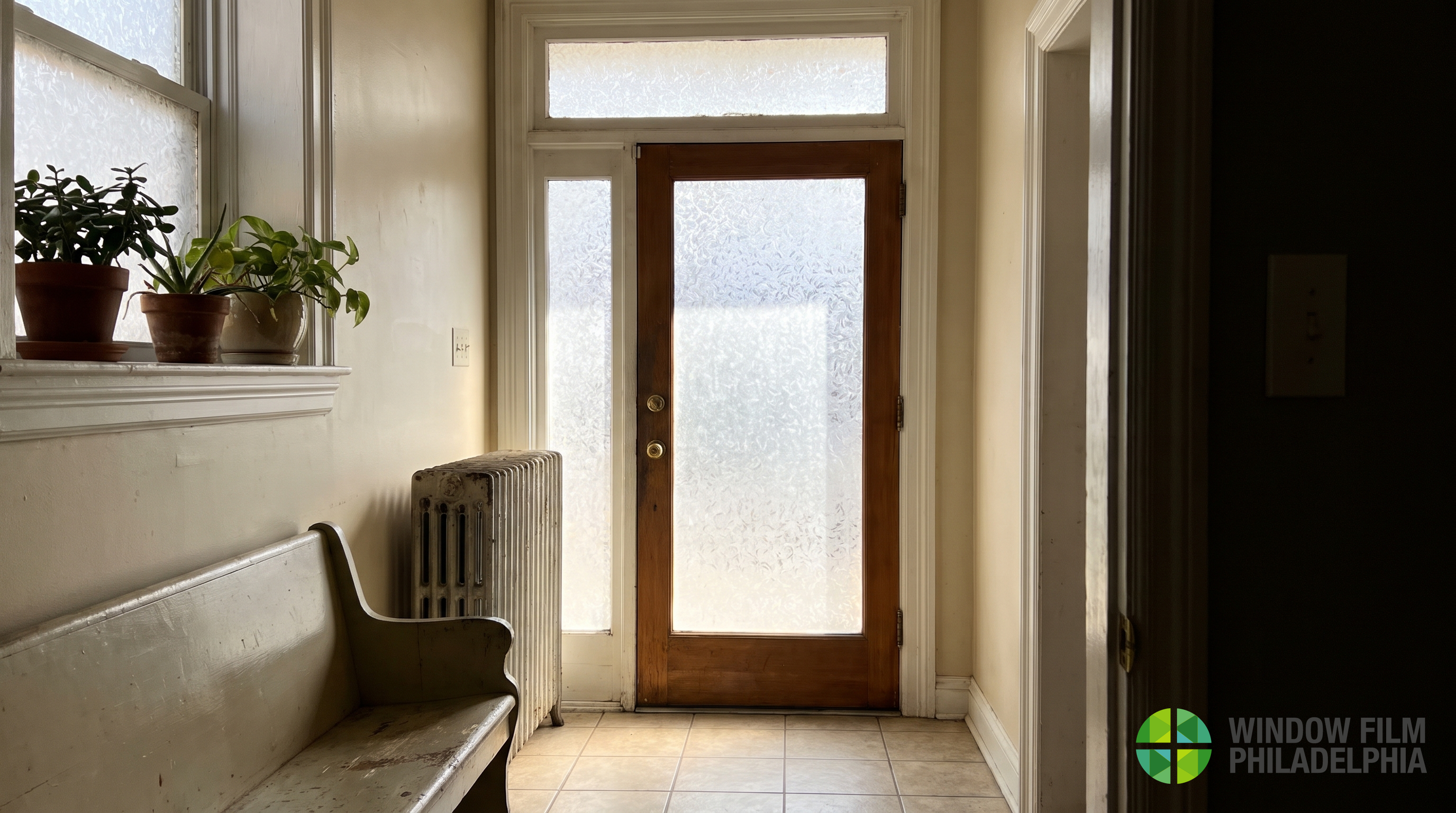
Fishtown rowhomes sit close enough to the sidewalk that a passerby can practically read the mail stacked on the front hall table. In Center City, condos face office towers across a narrow street. In South Philly, the classic rowhouse layout means bay windows that look straight into a neighbor’s living room. Dense living is part of what makes this city charming, and it is also why glass — not walls — ends up being the weak point in most home privacy plans.
Type privacy window film philadelphia into a search engine and you will find everything from mirrored one-way tints to frosted film that turns clear glass into something closer to a shower door. The options sort out cleanly once you understand what each type of film actually does, how much daylight it keeps, and how it behaves after dark. The sections below break down the main categories and the product details that matter most for rowhomes, twins, and condos across the city.
Privacy is also a bigger deal in an older city than the square footage suggests. Narrow side setbacks and shared party walls mean a ground-floor bedroom or a second-floor bath can be visible from a neighbor’s property line, and the most successful solutions tend to be the ones you never notice from inside the room.
Why Dense Urban Living Makes Privacy a Design Problem
Philadelphia’s housing stock amplifies the privacy problem in ways suburban homeowners rarely face. Many rowhomes in Fishtown, Queen Village, and Passyunk still have their original tall double-hung windows — gorgeous, but often single-paned and set only a few feet from a public sidewalk. Condos around Rittenhouse Square and Old City face other glass towers head-on, and the hillside rows in Manayunk put neighboring kitchens directly in each other’s sightlines. The closer the glass sits to the street, the less a standard window treatment can do on its own.
Traditional fixes come with real trade-offs. Heavy curtains restore privacy but block the daylight that many Philadelphia homes depend on, since rowhomes typically pull natural light from only one or two walls. Blinds need constant adjusting, collect dust on original woodwork, and do nothing about the heat that pours through single-pane glass in July. Federal building science research on window attachments makes the case for glass-based solutions, noting that the right window treatment can reduce glare and solar heat gain while preserving natural light — which is exactly the balance privacy film strikes. That balance is one reason privacy film for homes and condos has become such a common request in older urban neighborhoods.
Historic architecture adds another layer to the decision. In districts like Society Hill and Chestnut Hill, original wavy glass and wood sash are often protected features that homeowners do not want to replace. Film is reversible and installs directly on the existing pane, so character-defining windows keep their look while gaining privacy. It is a meaningful option in a city where so much of the housing predates modern zoning setbacks by a century.
Frosted and Decorative Film for Daytime Privacy
For most homeowners, the first question is simple: how do you keep the view in without living behind a curtain? Frosted and decorative films answer that for glass where the view out matters less than the light. These films diffuse sightlines completely while transmitting a high percentage of visible light, so a bathroom or front door stays bright even when it is fully private.
Two product lines cover this territory well. Solyx decorative films are the workhorse option, offering a deep catalog of textures and patterns at a friendly price point — a popular fit for rental units and first-floor rowhome windows where coverage matters more than signature design. 3M Fasara glass finishes sit a step up, with architectural patterns that read like expensive etched or laminated glass: linear gradients that fade from opaque to clear, geometric dot matrices, and woven-textile looks inspired by shoji screens. Fasara films carry a uniform, glass-like finish that holds up in steamy bathrooms and bright southern exposures alike.
The Solyx catalog is broader than most homeowners expect, with matte frost, satin, rice paper, stained-glass color, and cut-glass simulations that suit everything from a Victorian stair landing in Germantown to a minimalist condo bath. Because the film applies to the interior surface of the glass, patterns stay crisp and cleaning is as simple as any other window.
It is worth contrasting these with the mirrored tints many people picture first. A reflective film does deliver strong daytime privacy, because the brighter side of the glass becomes the visible side. The trade-off is the look: a mirror finish changes the character of an original window, and it behaves very differently once the sun goes down — which is the subject of the next section.
Common applications around the city include:
- Frosted bands on the lower sash of a Fishtown or Point Breeze bay window, blocking the street view while the upper sash stays open to the sky
- Full-coverage film on bathroom and half-bath windows in Queen Village and Society Hill homes, where original glass sits close to neighboring buildings
- Patterned Fasara film on transoms, sidelights, and front door glass in Manayunk twins, adding privacy and an architectural detail at the same time
- Decorative film on glass partitions in converted lofts and condos, where interior privacy matters as much as the street face
Nighttime Privacy with 3M Night Vision Series
Frosted film solves daytime privacy beautifully, but it changes the whole look of a window, and it is not the right answer for a living room where the view is part of the point. That is where reflective film traditionally came in — and where it also failed. A mirrored film works like a one-way mirror only while the outside is brighter than the inside. After sunset, with lamps on and the street dark, the effect flips: the interior becomes the bright side, and a reflective film turns your living room into a lit stage for the whole block.
3M Night Vision Series was engineered to solve exactly that problem. The line spans a 15–35% VLT range, so there is a version for nearly every light requirement, from a bright south-facing great room down to a dimmer street-facing bedroom. What sets it apart is low interior reflectivity — a fraction of what standard reflective films produce — which means interior lighting does not bounce back into a mirror effect at night. You keep a natural view out after dark without broadcasting the inside of your home to the sidewalk.
Choosing within the range comes down to the room. Night Vision 35 preserves the most visible light transmission and suits living rooms and dining rooms where daylight matters and the view out is a priority. Night Vision 15 leans darker, which suits bedrooms, media rooms, and condos with punishing western exposure where heat and glare are as much a concern as privacy.
The series also carries the heat- and UV-control benefits 3M is known for, blocking up to 99.9% of the sun’s UV rays to protect flooring, rugs, and upholstery from fading. For a first-floor living room facing a busy South Philly street, Night Vision 35 delivers evening privacy, glare control, and UV protection for interiors in a single layer that reads nearly invisible from inside the room.
What Privacy Window Film Philadelphia Homeowners Really Need
So which option fits which window? The right answer depends on the room, the orientation, and how close your neighbors actually are. Homes in Old City or Graduate Hospital sit nearly shoulder to shoulder with the house next door, while a penthouse condo in Northern Liberties may worry more about glare than the view in. Use these pairings as a starting point:
- Street-facing bay windows and front doors on rowhomes: frosted bands or gradient Solyx patterns on the lower half, leaving the upper sash clear for light and sky
- Bathrooms and first-floor bedrooms: full-coverage frosted film, which delivers complete privacy around the clock regardless of interior lighting
- Living rooms and dining rooms with a view worth keeping: 3M Night Vision in the 35% VLT range, giving daytime and evening privacy without a mirrored appearance
- Condos and lofts with serious sun exposure: Night Vision 15 or 35, combining privacy with meaningful heat rejection on west- and south-facing glass
- Interior glass partitions and home offices: 3M Fasara decorative patterns, which add privacy while doubling as a design element
One honest caveat belongs in any privacy conversation: no film provides true one-way privacy at night. If a room is brightly lit and the window is uncovered, people outside can see in regardless of which film is on the glass. The practical fix is pairing the right film with a lightweight blind or shade for the hours when you want the lights fully up — a much smaller visual footprint than living behind blackout curtains every evening.
What Installation Looks Like in a Rowhome or Condo
Film installation is far less invasive than most homeowners expect. There are no mounting holes to drill, no hardware to attach to original woodwork, and no tracks to clean. A typical visit starts with precise measurement of each opening, followed by a thorough cleaning of the glass — dust and grit trapped under film are the main cause of visible flaws, so this step gets real attention. The film itself is applied with a slip solution and squeegeed to a bubble-free finish, and most residential projects are completed in a single visit.
Curing is the only part that requires patience. The slip solution needs time to evaporate, which can take a few weeks depending on film type and season, and a faint haze or water pocket during that period is normal and temporary. Once cured, the film needs nothing more than standard glass cleaning. That low-maintenance profile is a big part of the appeal in a city where historic sash should stay untouched.
Talk to a Philadelphia Privacy Film Specialist
Every window in a Philadelphia home is a little different — original wavy glass in a Society Hill rowhouse, a modern tilt-turn unit in a Fishtown renovation, floor-to-ceiling glass in a Northern Liberties condo. A short consultation with a local installer takes the guesswork out of matching film to window, with real samples you can hold up to your own glass instead of another generic privacy window film philadelphia search result.
Ready to see what the right film would look like on your windows? Schedule a free consultation and get a quote built around your home, your light, and your budget.