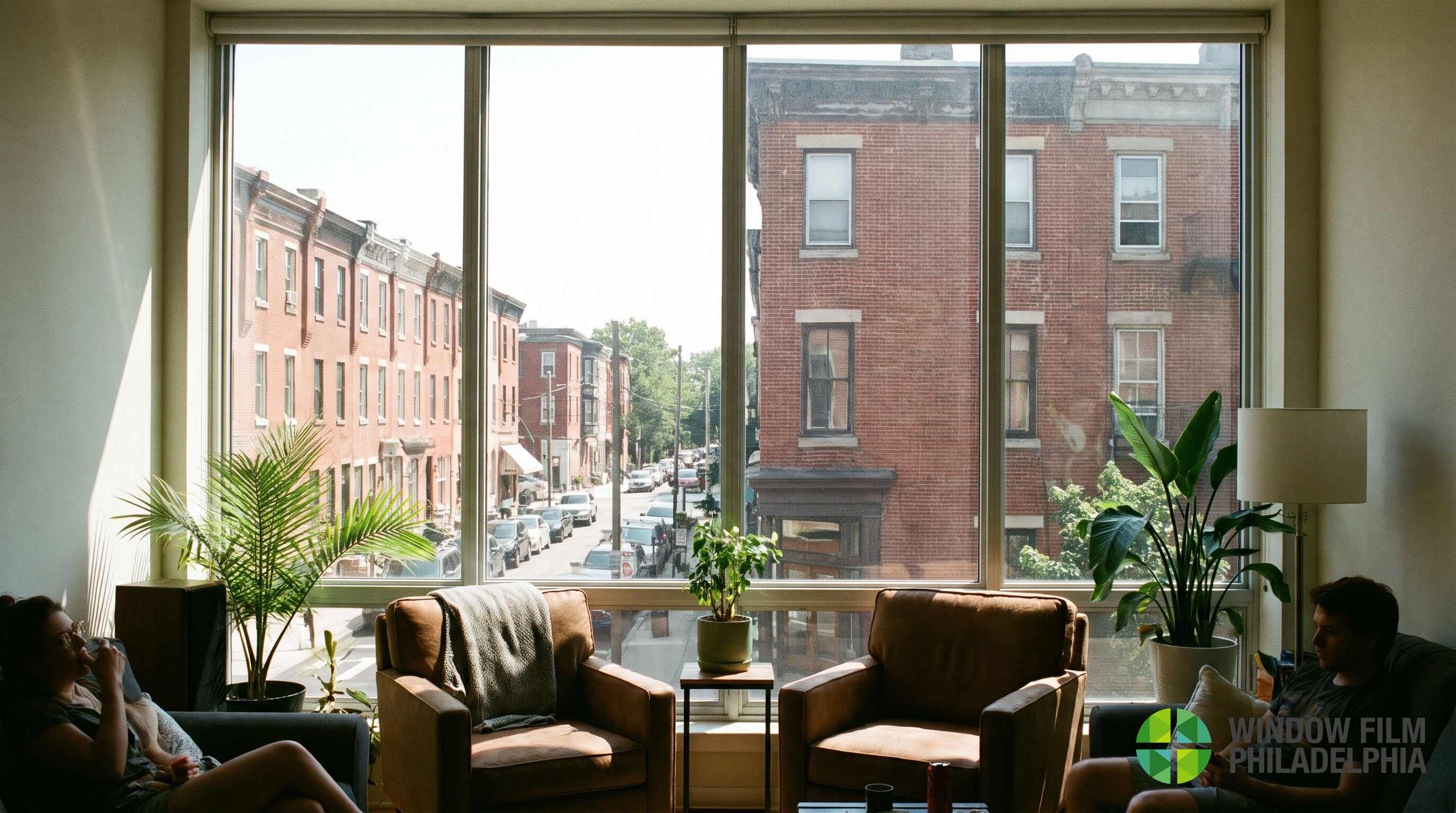
Philadelphia summers push Center City row homes, Fishtown conversions, and Rittenhouse condos to their thermal limits. Wide south-facing windows that look out over Fairmount Park or a South Philly rooftop can feel like open oven doors by mid-July, and homeowners weighing solar shades against window film usually want a straight answer about which one actually keeps the heat out. Does window tint block heat better than a fabric shade hung in front of the glass? The honest answer is that the two work at different points in the heat-transfer process, and for many Philadelphia homes the film delivers stronger total solar performance while the shades solve a different set of problems.
How Each Approach Stops Heat
A solar shade intercepts sunlight after it has already passed through your glass. The fabric absorbs or reflects a portion of that energy in the room, which is why an open-weave shade can still leave the windowpane itself hot to the touch. Window film works earlier in the chain: it is bonded to the glass surface and rejects solar energy at the pane, stopping a measurable share of the sun’s heat before it ever enters the room. Because the glass itself becomes part of the rejection system, film also cuts the radiant heat that pours off a sun-struck pane long after the shade would have been raised to keep the view. This single-pane greenhouse effect is exactly why film blocks heat more effectively than fabric alone in many rooms: it interrupts solar energy at the glass, before it can be absorbed and re-radiated toward you.
That difference matters in Philadelphia’s row-home stock, where Victorian and colonial-era windows in neighborhoods like Old City and Manayunk often came in large, single- or storm-glazed openings. A shade can only treat the light it catches; film upgrades the performance of the entire opening, day and night, with nothing to raise, lower, or reposition.
So, Does Window Tint Block Heat?
The answer depends on the film, and the numbers make the case clearly. If you have ever wondered whether does window tint block heat holds up under scrutiny, the honest test is total solar energy rejection rather than a single marketing percentage. Modern spectrally selective films such as 3M Prestige reject roughly half of total solar energy even in a light, view-neutral shade: the 3M Prestige 70 series carries a TSER of about 50 percent, meaning half of the sun’s total heat load never makes it into the room. Prestige films are also engineered to reject up to 97 percent of the infrared portion of sunlight, which is the band responsible for that burning, radiant feeling on your skin near a hot window. Meanwhile, 99 percent of damaging UV light is blocked, protecting floors, rugs, and furniture from fading.
For homes that need insulation as much as solar control, 3M Thinsulate window film adds a low-emissivity layer that improves the window’s ability to hold heated air inside during winter and slow heat gain in summer. That dual-season behavior is hard for any roller shade to match, because a shade’s benefit stops the moment it is opened.
To put those figures in context, the U.S. Department of Energy’s Federal Energy Management Program guidance on purchasing energy-efficient residential windows, doors, and skylights notes that solar heat gain through glazing is one of the largest drivers of summer cooling loads, which is why treatment products are evaluated on total solar energy rejection rather than visible darkness alone. A 50 percent TSER film can meaningfully trim cooling costs in a hot, humid climate like Philadelphia’s without darkening a row home’s living room the way older tinted films did.
Where Solar Shades Still Make Sense
Solar shades are not the wrong tool; they are a different tool. If your priority is soft, diffused daylight with a modest heat reduction, or you want a fabric element that coordinates with a room’s design, shades can do that well. They also give you manual control over light throughout the day, which some homeowners in sunny top-floor condos appreciate.
The trade-offs are worth naming before you buy:
- A shade blocks the view whenever it is doing its best work, while quality film stays visually neutral.
- Shades do nothing for winter heat retention or UV protection when raised, and fabric can fade over years of sun exposure.
- Large South Philly or University City windows with direct sun can still heat the glass behind an open-weave shade, radiating into the room.
For many Philadelphia homeowners, the strongest result comes from film on the glass paired with decorative treatments elsewhere in the room, giving you full-time solar control without giving up the window itself.
Comfort Beyond the Numbers
Heat rejection is only part of the story. A hot west-facing window in a Fishtown row home does not just raise the thermostat; it sends glare across televisions, laptop screens, and dinner tables. Films can be selected to cut glare substantially while preserving natural light, and the same installation addresses the fading of hardwood floors and heirloom upholstery. You can read more about how those benefits break down in our guides to glare reduction and UV blocking window film in Philadelphia.
Installation and Building Considerations
Old City row homes and Society Hill properties sometimes sit inside historic districts where exterior modifications face review, but window film is applied to the interior surface of existing glass and leaves the exterior appearance essentially unchanged. That makes film one of the least invasive performance upgrades available for Philadelphia’s older housing stock. Modern films are also compatible with most residential glazing systems when matched correctly to glass type, which is why a professional assessment matters before installation. If you are weighing film against full window replacement, our page on energy savings from window film walks through how film performance compares with new glazing at a fraction of the disruption.
Choosing the Right Fit for Your Philadelphia Home
The practical decision comes down to what you want the window to do. If the goal is to cut the heat load on a big south- or west-facing wall of glass in a Center City or Manayunk row home, film is the stronger performer, and a 50 percent TSER, 97 percent IR-rejecting Prestige film will outperform a comparable shade at the glass. If your priority is light diffusion and design flexibility, shades deserve a look, and a combined approach is common.
Our team installs 3M window film across Philadelphia and the surrounding neighborhoods, and you can see the product range we carry on our 3M window film page, or browse more guides like this one in our blog. For residential projects from Fishtown trinities to Graduate Hospital townhomes, our homes and condos application page covers what to expect from a typical installation.
Get a Free Solar Control Consultation
If you are still deciding whether window film or solar shades is the better call for your home, the fastest way to find out is a free on-site assessment. We will measure your glass, review orientation and shading, and show you exactly how much solar heat a film matched to your windows could reject. Contact us today for a free quote, and see for yourself how much heat window tint can block, and does window tint block heat better than shades, with a free quote for your Philadelphia home this summer.