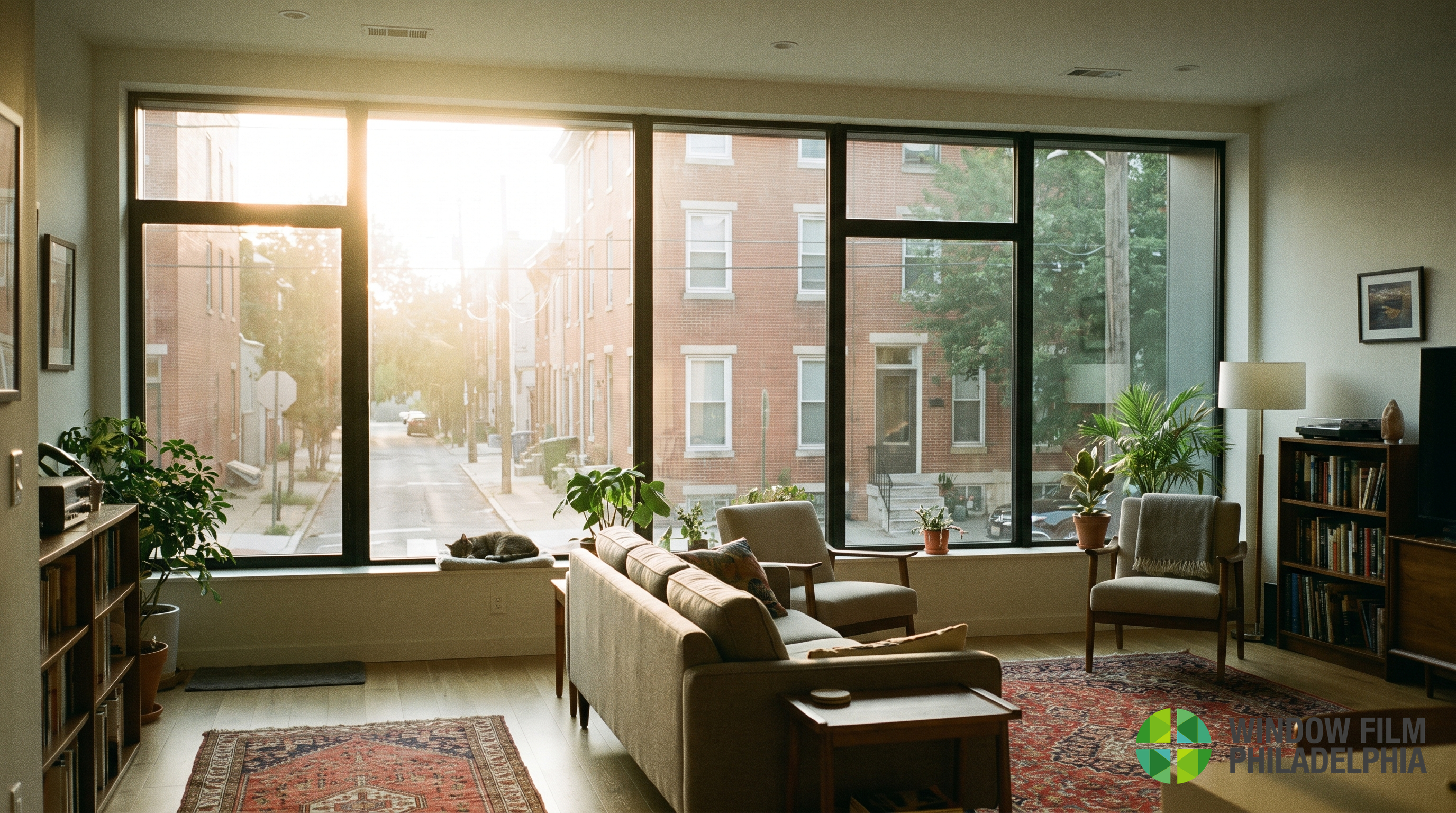
Philadelphia summers push air conditioners hard. By mid-July, a south-facing rowhome in South Philly can feel like a greenhouse, and Center City offices with single-pane glass turn into ovens long before noon. So does heat blocking window film work, or is it just clever marketing? The short answer is yes — when you match the right product to the right glass. Modern solar-control films reject a meaningful share of the sun’s infrared energy before it ever becomes heat inside your rooms. For Philadelphia homeowners weighing comfort against a full window replacement, film is the faster, far cheaper lever to pull first.
How Solar Heat Gets Through Philly Glass
Every pane of glass in your Philadelphia home or business is a gateway for solar energy. The sun’s radiation hits the glass in two heat-carrying forms: visible light you can see and infrared energy you feel as warmth. The fraction of that solar energy admitted through a window is measured as the Solar Heat Gain Coefficient, or SHGC — a rating between 0 and 1 where lower means less heat passes through. The U.S. Department of Energy’s guide to energy-efficient windows explains how SHGC and U-factor together determine how much unwanted heat a window lets in, and why those ratings matter when you are sizing an air conditioner.
Untreated single-pane glass, common in older Philadelphia rowhomes and historic Center City buildings, carries a high SHGC. That is exactly why those rooms overheat so fast on a clear afternoon — the glass lets solar energy stream in all day, but it has no way to stop it from turning into interior heat.
Does Heat Blocking Window Film Work? What the Performance Data Shows
When the afternoon sun is beating on a Broad Street storefront or a Manayunk living room, the question is whether film can keep up. It can, and the proof is in the metrics manufacturers report. 3M window film in the Sun Control Prestige series uses non-metalized nanotechnology to reject infrared energy without darkening the glass. The 3M Prestige PR70 film, for example, delivers a 50% Total Solar Energy Rejected (TSER) rating while keeping visible light transmission high — and it rejects 97% of infrared light.
One important distinction: 97% IR rejection is not the same as 50% TSER. TSER is the whole-window heat number that actually reflects how much cooler your room will run, because it accounts for visible light, infrared, and UV combined. IR rejection sounds more impressive, but TSER is the figure to compare when you are shopping for real heat reduction.
Ceramic options from LLumar and Vista work on the same principle — absorbing and reflecting solar energy at the glass surface rather than letting it pass through and convert to heat. Unlike older dyed films that fade and lose performance over time, ceramic and nanotechnology films hold their numbers for years, so the heat rejection you measure on day one is the heat rejection you still get a decade later.
What the Numbers Mean for Philadelphia Comfort
Translating lab ratings into real-world comfort takes a little context. Here is what a 50% TSER rating actually does inside a typical Philadelphia space on a 90-degree August afternoon:
- It cuts the solar heat pouring through the glass roughly in half, so your HVAC cycles less and rooms stay closer to your thermostat setpoint.
- It lowers the effective SHGC of an untreated pane dramatically — the same metric Energy Star uses to certify efficient replacement windows.
- It reduces hot spots, those uncomfortable zones near west-facing windows in Fishtown and University City that make whole rooms feel uneven and stuffy.
The practical payoff is steady, even comfort instead of a broiling perimeter with an overworked air conditioner fighting in the middle. Lower solar gain also means your cooling system runs fewer hours, which trims peak-demand charges for Philadelphia businesses on commercial rate structures.
Ceramic Versus Dyed Film for Philadelphia Summers
If you are comparing options, the film chemistry matters as much as the brand. Dyed films absorb solar energy into the glass and rely on airflow to carry it away — they are inexpensive but can fade and lose efficiency after a few Philadelphia summers of intense sun. Ceramic and metalized films, by contrast, reflect and selectively absorb infrared at the surface, which means less heat ever enters the room. For a hot, humid climate like Philadelphia’s, where west-facing glass bakes from June through September, a ceramic film preserves both clarity and cooling performance over the long haul. The slightly higher upfront cost usually pays back in comfort and lower cooling bills well before the film reaches the end of its warranty. For buildings along busy transit corridors, where glass faces reflected heat from pavement and neighboring facades all day, that sustained performance makes ceramic the sensible default for Philadelphia’s longest sun exposures.
Where Heat Blocking Film Makes the Biggest Difference in Philadelphia
Not every window needs the same treatment, but some Philadelphia settings see outsized gains from solar-control film. South- and west-facing walls in Center City high-rises absorb the brunt of the afternoon sun; a thin ceramic layer on those panes can drop the perceived temperature by several degrees without blocking the skyline view. Ground-floor rowhomes in South Philly and Old City often have single-pane sash windows that waste energy season after season — film gives those historic openings a heat shield without changing their character or running afoul of preservation guidelines.
Storefronts along commercial corridors benefit too, because cutting solar gain also eases glare on displays and keeps shoppers comfortable near the glass. And because the same films block 99% of UV, they double as UV protection for hardwood floors, artwork, and merchandise that would otherwise fade. Pairing heat rejection with energy savings means one installation solves multiple summer problems at once.
Signs Your Philadelphia Windows Need Heat Blocking Film
You do not need a thermal camera to spot the problem. A few telltale signs tell Philadelphia property owners it is time to consider solar-control film:
- Rooms on the sunny side of the building run five to ten degrees warmer than the rest, even with the air conditioning on.
- Blinds and curtains stay closed all summer just to keep the heat tolerable.
- Furniture, rugs, or product displays near the glass show fading or discoloration from sun exposure.
- Energy bills spike in July and August far out of proportion to the rest of the year.
- You avoid sitting near certain windows because they radiate heat like a space heater.
If two or three of those sound familiar, film will pay for itself in comfort and cooling savings faster than you might expect.
Get a Heat Blocking Window Film Quote in Philadelphia
So, does heat blocking window film work for your Philadelphia property? The honest answer is that it works very well — when the film is matched to your glass, your sun exposure, and your goals. The wrong product on the wrong window underperforms, which is exactly why a professional assessment matters. Our team measures your glazing, identifies the hot zones, and recommends a 3M, LLumar, or Vista film tuned to Philadelphia’s climate and your building. Contact us for a free quote and find out how much cooler your rooms can be without replacing a single window.