
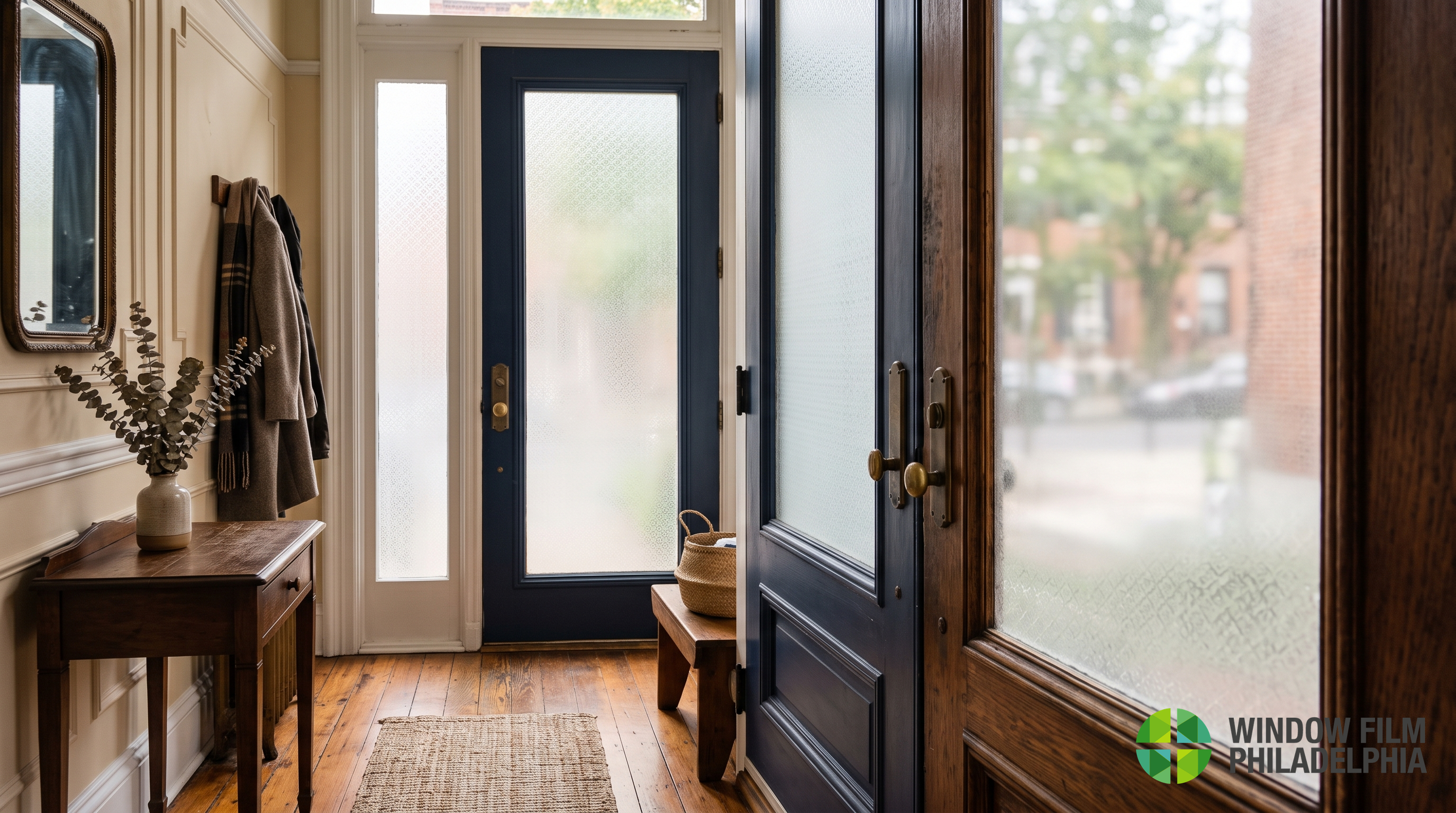
The best window film for nighttime privacy philadelphia homes need starts with a simple fact: interior lights turn unprotected glass into a stage, and living along a narrow South Philly block or in a Society Hill rowhome means living close enough to neighbors that a drawn shade after dark becomes the default. Anyone on the sidewalk, in the next rowhome, or across an alley sees silhouettes and furniture as clearly as if the curtains were open. Nighttime privacy film addresses the problem at the glass itself, keeping sightlines blocked after sunset without sacrificing daylight, views, or the natural light that Philadelphia’s older homes depend on.
The fishbowl effect is worst in the neighborhoods where glass is most abundant. Townhouses in Northern Liberties and Fishtown with floor-to-ceiling rear facades, condos near the Schuylkill with river views, and third-floor flats in University City all lose their daytime seclusion the moment a room light switches on. A correctly specified film prevents that, and it does so without the cave-like feel of blackout shades.
Why Nighttime Privacy Film Matters in Philadelphia
Why Standard Reflective Film Fails After Dark
Daytime reflective films work on a one-way principle that only exists while the sun is up. Glass coated with a metalized layer reflects bright daylight back toward the street, so anyone outside sees their own reflection instead of your living room. The moment interior brightness exceeds exterior brightness, the effect reverses. Your window becomes a mirror pointed inward, and anyone outside sees a clear, brightly lit view of everything inside. On a dense Point Breeze or Passyunk Square block, that reversal happens at dusk and lasts until the lights go out.
This is the gap that quality nighttime privacy film closes. Rather than relying on reflection alone, it pairs a modest exterior appearance with a low interior light transmission, so the view from outside stays muted regardless of which side is brighter. The result holds through dinner, a late work session, and the last lights-out of the evening.
A properly specified film gives you more than seclusion, which is why the upgrade has become so common across Center City and the river wards.
- Round-the-clock seclusion that never reverses at dusk, so curtains stay open after dark.
- Lower cooling loads during Philadelphia’s humid July and August stretches, when south- and west-facing glass drives indoor temperatures up.
- Rejection of up to 99% UV rays, which protects hardwood floors and upholstery in older homes from fading.
- Reduced screen glare on home-office monitors and living-room televisions, day and night.
Top Nighttime Privacy Film Types for Philadelphia Homes
Not every privacy situation calls for the same product. The right choice depends on how much natural light you want to keep, how much heat you need to reject, and whether the glass faces a busy sidewalk or a private rear courtyard. Below are the three film categories that handle after-dark seclusion best, and where each performs strongest.
Reflective and Dual-Reflective Films
Traditional reflective film uses a metalized layer to bounce daylight away from the glass, creating strong daytime seclusion on busy streets like Front Street or Girard Avenue. Its weakness is the dusk reversal described above: once interior lights dominate, the one-way mirror flips and the room becomes visible from outside.
Dual-reflective films soften that weakness by pairing a reflective outer surface with a more neutral inner one. The exterior stays uniformly reflective through the evening, so the inward mirror effect is far less pronounced than with single-layer products. These films suit homeowners who want maximum daytime heat rejection with dependable day and night privacy, especially on sun-exposed front facades.
Ceramic and Nano-Window Films
Ceramic films take a different approach: instead of reflecting light with metal, they use nano-ceramic particles to absorb and reject solar energy while keeping the glass visually neutral. Because they do not rely on a mirrored surface, they never create the reversed fishbowl effect in the first place. A dark ceramic film blocks enough outgoing light to mute interior visibility after dark while preserving clear views and true color from inside.
This category is the strongest all-around performer for Philadelphia homes. Ceramic films reject up to 97% IR heat, block 99% UV rays, and reach up to 60% TSER on high-performance 3M lines while transmitting enough natural light to keep a rowhome interior feeling open during grey winter months. They pair particularly well with 3M Night Vision window film, which uses a low-reflectivity construction to keep views crisp in both directions. For independent guidance on film performance standards, the International Window Film Association publishes selection resources installers and manufacturers follow nationwide.
Frosted and Decorative Films
Some rooms need absolute seclusion at every hour, not just after dark. Bathrooms, ground-floor powder rooms, front sidelights, and first-floor windows that face a sidewalk all fall into this category. Frosted and decorative films from brands like Solyx and 3M Fasara solve it with a translucent layer that turns clear glass into a diffused panel, blocking the view entirely while still admitting soft natural light.
Because these films read as permanent design features, they suit spaces where privacy must never lapse. A frosted sidelight beside a Society Hill front door, a bathroom window facing a narrow mid-block passage, or a ground-floor bedroom window on a busy Passyunk Avenue block all benefit. Decorative options also add texture and design value, which matters where original glass is part of the character.
Choosing the Best Window Film for Nighttime Privacy Philadelphia Homes
The right product depends on three practical questions: what the room is used for, what kind of glass it sits on, and how dark you want the interior to feel. Walking through these questions before installation prevents the most common mistake—choosing a film so dark it makes the space feel enclosed, or so light it fails to do the job after dark.
Match the Film to the Room
Different rooms carry different priorities. A home office in a Rittenhouse condo needs glare control and screen comfort; a first-floor living room in Fishtown needs seclusion from street-level foot traffic; a bathroom needs complete, permanent opacity.
- Living rooms and dens benefit from ceramic or dual-reflective films in the 20% to 35% VLT range, which keeps interiors comfortable while blocking after-dark views.
- Bedrooms suit darker films, often paired with room-darkening drapes for complete blackout when wanted.
- Bathrooms and sidelights are best handled with frosted or decorative film, which delivers full opacity around the clock.
- Home offices do well with lighter ceramic films that reduce glare without dimming the workspace.
Consider Glass Type and Age
Philadelphia’s housing stock ranges from eighteenth-century windows with wavy hand-blown glass to brand-new double-pane units in Northern Liberties construction. Older single-pane glass handles film differently than modern insulated units, and some films are rated specifically for one or the other. A professional installer will confirm compatibility before recommending a product, which is especially important in historic districts where original windowpanes may be part of a protected facade.
Set the Right Visible Light Level
Film darkness is measured as visible light transmission, or VLT. A 15% VLT film admits roughly a seventh of the available daylight, which reads as a dim, comfortable interior with strong seclusion. A 35% VLT film keeps a room noticeably brighter and still mutes after-dark visibility considerably. Balancing VLT against room function is the single most important decision, and it is worth working through with an installer.
Nighttime Privacy Film Versus Blinds, Curtains, and Shades
Window coverings have always been the default answer to after-dark visibility, and they do work. But they come with tradeoffs that film does not, and comparing the two clarifies why so many homeowners now treat the glass itself.
- Coverage gaps. Vertical blinds and curtains leave openings at the edges, and sightlines through slats remain visible at an angle. Film covers the entire pane uniformly.
- Daytime light loss. Closing blinds to guarantee evening seclusion means losing daylight from mid-afternoon onward, especially in winter when the sun sets before five o’clock.
- Heat and UV performance. Coverings block light but do little to reject heat before it enters the room or stop the UV rays that fade hardwood floors. Film handles both while the blinds stay open.
- Maintenance. Blinds collect dust and need regular cleaning; film requires nothing beyond normal window cleaning.
The strongest setups layer both approaches: film handles solar control, UV rejection, and baseline seclusion, while lightweight drapes or top-down shades provide adjustable blackout for bedrooms. Treating them as a system rather than competing options gives the best result in most rowhomes and condos.
Nighttime Privacy Film FAQs
Here are answers to the questions Philadelphia homeowners ask most.
Will film make my home feel dark?
It depends on the VLT level you choose. A 15% VLT film noticeably dims a room, while a 35% VLT film keeps most natural light and still blocks after-dark sightlines. Most homeowners in Center City and Queen Village choose a mid-range VLT that preserves brightness while delivering seclusion.
Does privacy film also reduce heat?
Yes, when you choose a solar-control product. Ceramic films reject up to 97% IR heat and 99% UV rays, which makes a real difference during Philadelphia’s humid summer stretches. The same film that blocks evening sightlines keeps a south-facing living room noticeably cooler in July, compounding the energy savings window film delivers across a full heating and cooling season.
Can film be installed on double-pane windows?
Usually yes, but the correct film must be selected for the glass type. Modern insulated units handle specific films well, while others are rated only for single-pane glass, so an installer will confirm compatibility first.
Get a Nighttime Privacy Film Quote for Your Philadelphia Home
If evening visibility has turned your windows into a liability, the fix is straightforward. A quality privacy film delivers dependable day and night seclusion, meaningful heat rejection during humid summers, and UV protection for the floors and furnishings that make an older Philadelphia home feel like yours—without the cave-like feel of blackout shades or the upkeep of blinds.
The team at Window Film Philadelphia installs ceramic, dual-reflective, and frosted films across Center City, Fishtown, Manayunk, University City, and the surrounding neighborhoods. We will walk you through VLT options for each room, confirm the right film for your glass type, and help you choose the best window film for nighttime privacy philadelphia homeowners can rely on—then provide a written quote before any work begins.
Request a free consultation or call today to schedule your estimate for a day and night privacy upgrade.